


Artificial intelligence (AI) is no longer a distant concern for most workers. Many already feel its effects on the job today.
A questionnaire conducted on behalf of Campbellsville University (CU) surveyed 1,002 U.S. workers about how they see AI affecting their work, which careers they think are safest and what they’re doing to protect their own future. Workers already have strong opinions about which skills matter most in an AI-driven economy, and they’re acting on those beliefs.
Key Takeaways
- Nearly one in four U.S. workers (24%) is concerned about AI’s effect on their career, and 14% are rethinking their career because of AI.
- Gen Z is most likely to say their job feels less secure (30%) and most likely to already be rethinking their career because of it (17%).
- Specialized trade skills that are hands-on and physical rank as the No. 1 most AI-proof skill set, named by 51% of workers.
- Only 12% of workers say their employer is training them very well on AI tools or AI-related skills.
- 58% of workers have already taken action to future-proof their career against AI, most commonly by learning to use AI tools themselves (37%).
The AI Anxiety Index: What Workers Actually Fear
As AI becomes embedded in everyday work, its effects extend beyond productivity and output to the attitudes and anxieties of the workforce. This analysis examines how concern about AI is distributed across industries, generations and regions, as well as how that concern is influencing the way workers view their roles and career trajectories.
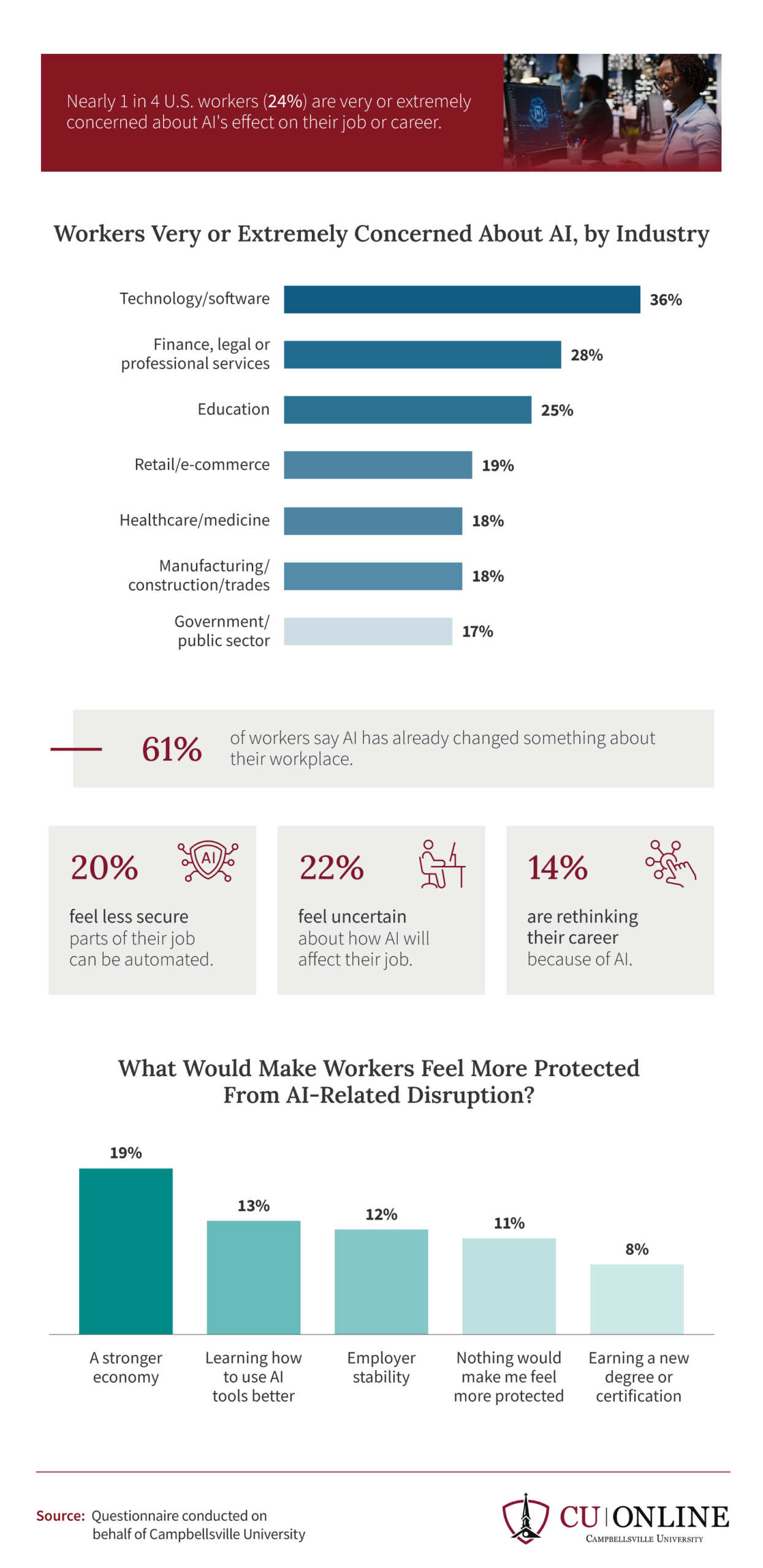
More than three in five workers (61%) said AI has already changed something about their workplace, while 22% said they are still uncertain about how AI would affect their role. Nearly one-quarter of workers (24%) said they are very or extremely concerned about AI’s impact on their job or career. Technology and software workers reported the highest level of worry of any industry (36%). In a smaller Kentucky subsample, 30% of residents also said they felt very or extremely concerned.
More than 1 in 10 workers (14%) said they are rethinking their career because of AI in the workplace. One in five reported feeling less secure because they know that parts of their job could be automated. Gen Z was the generation most likely to say AI has made their job feel less secure (30%) and the most likely to say they’re actively reconsidering their career because of it (17%).
Which Skills and Roles Americans Believe AI Can’t Touch
Not every job feels equally exposed to AI. The roles and skills seen as safest are those rooted in physical work, human connection and judgment that machines are not trusted to replicate.
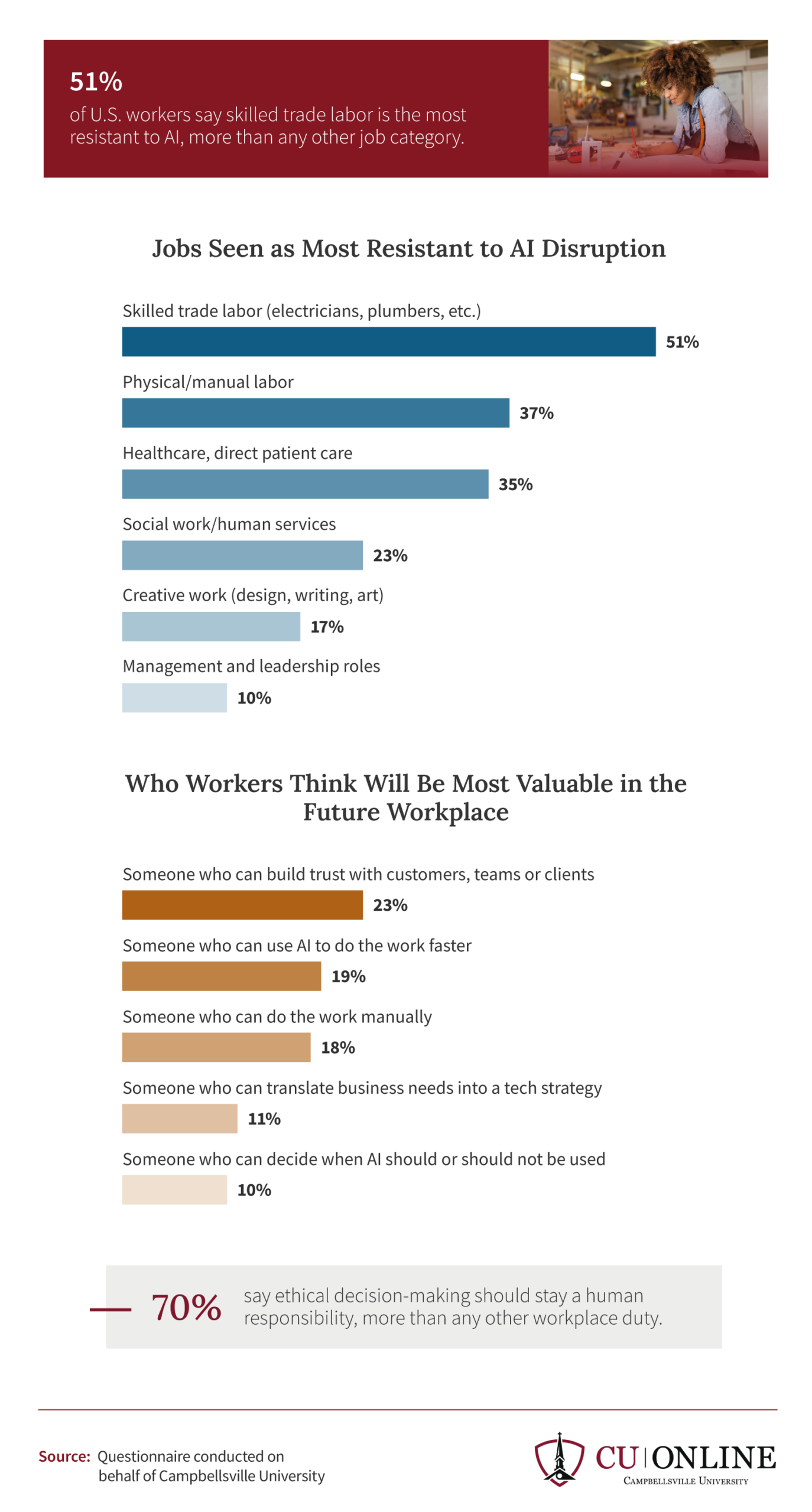
Skilled trade labor, such as electricians and plumbers, was the job category workers saw as most resistant to AI disruption (51%), more than any other category. Physical and manual labor (37%) and direct patient care roles in healthcare (35%) ranked just behind skilled trades, while purely technical work drew far less confidence.
Specialized trade skills (54%) and emotional intelligence (45%) topped the list of skills workers saw as most protected from AI, far ahead of technical IT strategy (7%). Workers also had a clear idea of who will matter most in the future workplace: 23% picked someone who can build trust with customers, teams or clients as the most valuable worker type. A majority (70%) also said that ethical decision-making should remain a human responsibility above all other workplace duties.
Considering a career that AI can't automate?
If you're a working RN ready to build on that strength, Campbellsville University's ACEN-accredited RN to BSN online program lets you advance your credential without pausing your job or your life.
Learn moreWorkers Take Career Protection Into Their Own Hands
Concern about AI hasn’t left workers standing still. Many have already started to future-proof their careers, taking steps to keep their skills relevant as AI changes what their jobs require. The most common move is a practical one. Rather than avoid the technology, workers are learning to use the AI tools now entering their fields, positioning themselves to work alongside AI instead of being replaced by it.
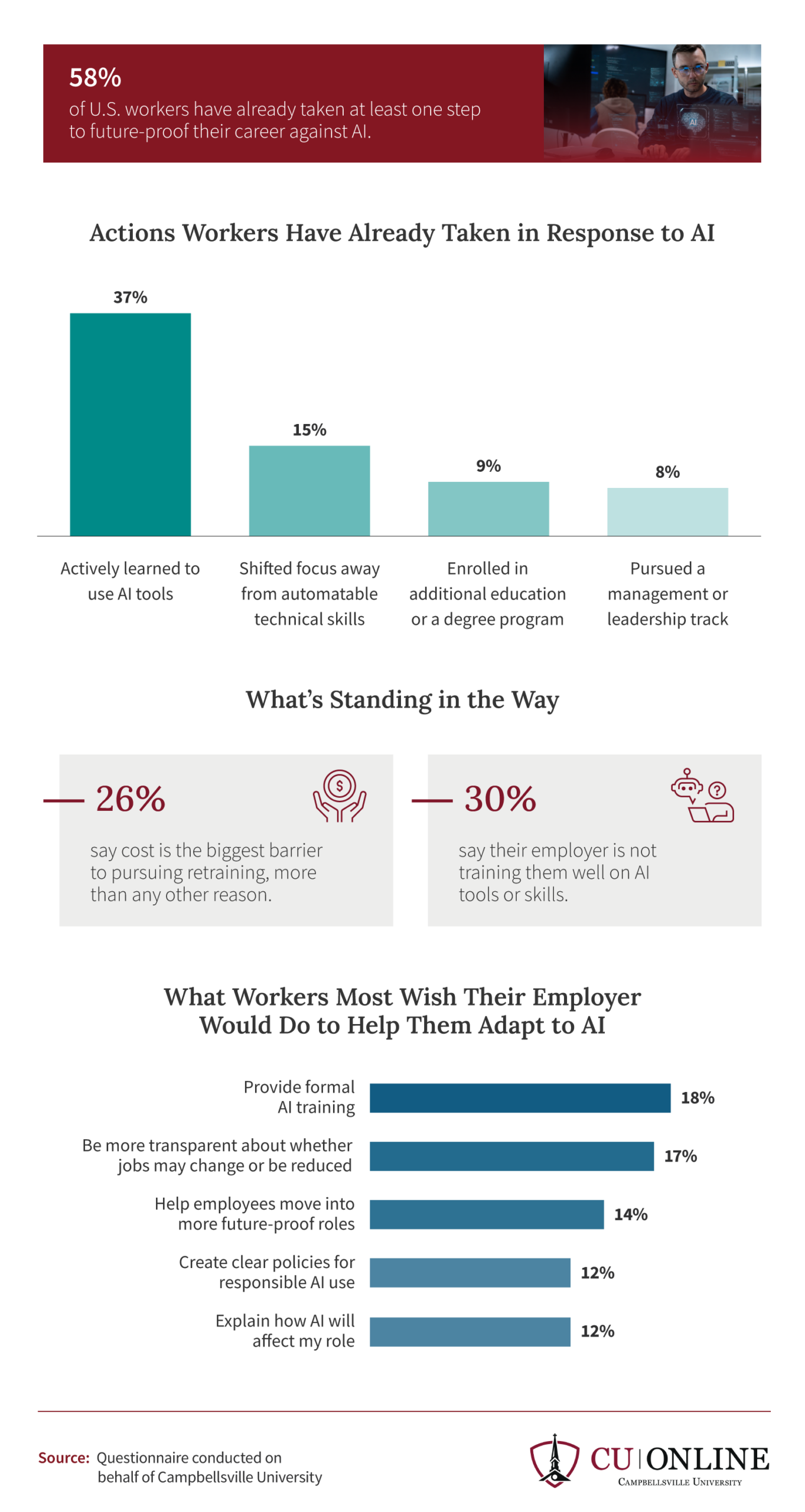
More than half of workers (58%) had already taken at least one step to future-proof their career against AI, most commonly by learning to use AI tools (37%). Gen Z moved fastest of any generation, with 65% saying they had already acted in response to AI. In the smaller Kentucky subsample, 55% said the same, which tracks with the national trend.
Despite that momentum, many workers feel unsupported. Only 12% said their employer was training them very well on AI tools or AI-related skills, while 30% said their employer wasn’t training them well. Asked what would help most, workers pointed to formal AI training (18%) and more transparency about potential job changes (17%) ahead of every other option.
Job Security Is Becoming a Do-It-Yourself Project
Across industries and generations, U.S. workers are drawing their own conclusions about which skills will matter most as AI continues to advance. They see human judgment, trust-building and hands-on expertise as the traits machines can’t easily replace.
Many aren’t waiting for employers to catch up before acting on that belief. As AI’s role in the workplace continues to grow, the workers who fare best may be those who started adjusting first.
Methodology
Campbellsville University commissioned this survey of 1,002 American adults, fielded from July 28 to August 3, 2026. Respondents represented a range of industries, job levels, generations and income levels, with an oversample ensuring representation from Kentucky. Of the full sample, 989 respondents were currently employed full-time, part-time or self-employed, and were asked the survey’s workplace- and AI-specific questions; the remaining 13 respondents (job-seeking, retired, students or not currently working) were excluded from those questions by design.
Generation was determined by asking respondents’ age and classifying them as Gen Z (18 to 24, 5% of respondents), millennials (25 to 44, 61%), Gen X (45 to 64, 30%) or baby boomers (65 or older, 2%); 2% of respondents did not state their age. Kentucky residents made up 2% of the sample (20 of 989). Because the Kentucky subsample is small (20 respondents), Kentucky-specific figures should be treated as indicative rather than statistically representative of Kentucky residents overall.
About Campbellsville University
Campbellsville University offers accredited online programs built for working adults who want career-relevant skills without pausing their job or life. CU’s ACEN-accredited RN to BSN online program builds on the kind of direct patient care and human-centered skills this survey found workers see as most resistant to AI disruption. Learn how it can help you advance your nursing career on a schedule that fits your life today.
Fair Use Statement
This report and its images are available for noncommercial reuse. If you use any of this content, please link back to this page and credit Campbellsville University.