

A call to ministry does not always arrive early in life. For some adults, it emerges in the middle of a career, after years spent building a family, paying a mortgage or working in another field. The interest may be real but pursuing it can mean weighing a new degree against responsibilities that are already firmly in place.
A questionnaire conducted on behalf of Campbellsville University surveyed 589 American adults about ministry, theological education and spiritual leadership, including regular churchgoers and people who never attend religious services. The findings point to a sizable group of people who have considered ministry without acting on it. The findings also show wide acceptance of online theological education and concern about whether communities will have enough spiritual leaders in the years ahead.
Key Takeaways
- 38% of Americans have considered ministry, seminary, chaplaincy or another faith-based leadership role, and 74% of that group never took a step toward pursuing it.
- Only 42% of Americans believe their community has enough pastors and other spiritual leaders. Looking 10 years ahead, that share falls to 38%.
- 60% of Americans say a pastor trained entirely online is as credible as one trained on campus.
- Among those who have considered a faith-based leadership role, 55% would be likely to enroll in a fully online graduate-level theology or ministry program.
- 33% of those who considered a theological or ministry degree say not feeling qualified kept them from pursuing it, while 28% were held back by program costs.
The Calling Many Americans Have Yet to Pursue
For a substantial share of adults, the idea of ministry has already crossed their minds. For many of them, however, that interest has not yet turned into action.
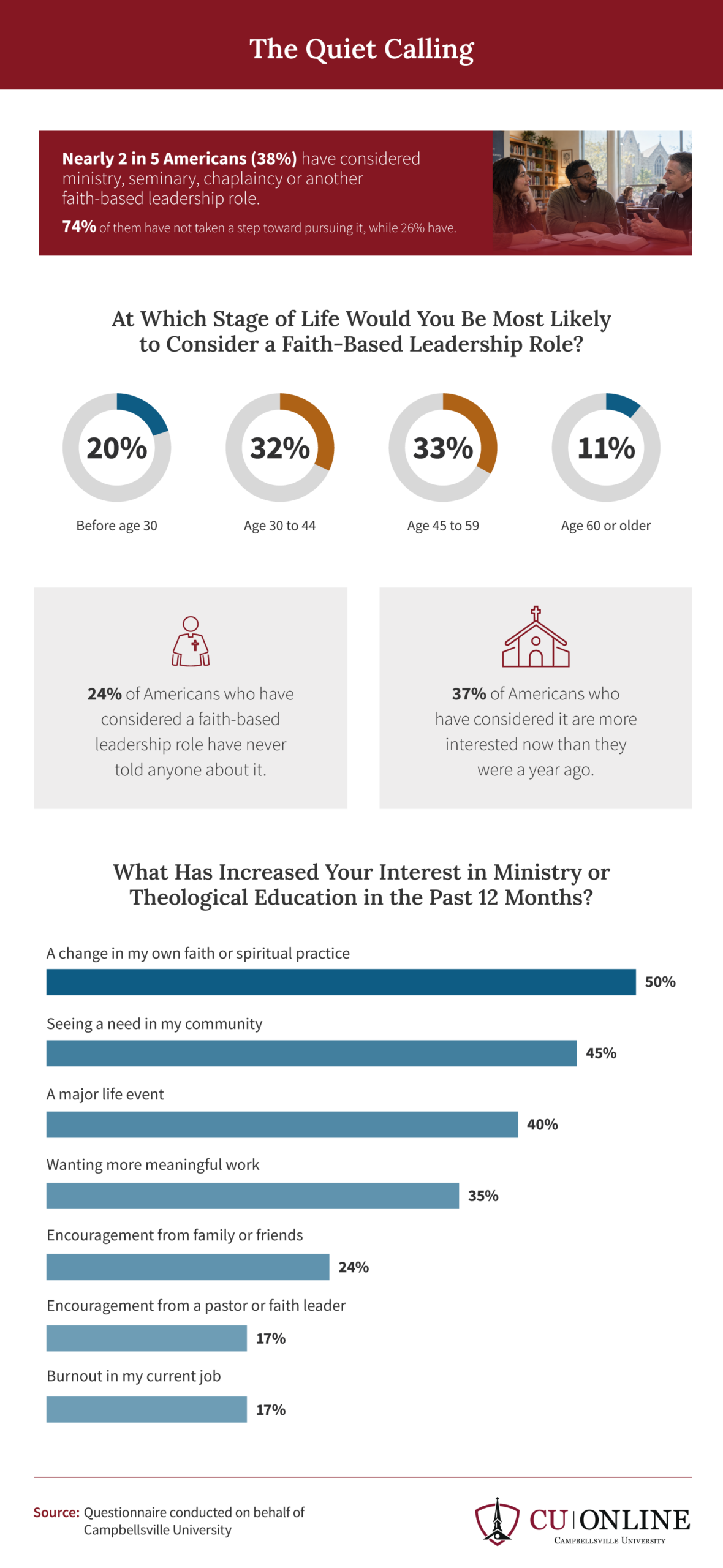
There exists a meaningful gap among this group of Americans between considering a ministry role and taking the first step toward it. Nearly two in five Americans (38%) have considered ministry, seminary, chaplaincy or another faith-based leadership role. Yet, about three-quarters of those adults (74%) said they never took a single step toward pursuing it.
For some, interest is becoming stronger rather than fading. Among Americans who have considered ministry, 37% said they are more interested now than they were a year ago. This change was most often driven by a shift in their own faith or spiritual practice (50%), followed by a perceived need in their community (45%).
Americans See a Need for Spiritual Leadership
Americans are not especially confident that their communities have enough spiritual leaders today. Their expectations for the future are even more cautious.
Only 42% of Americans believe their community currently has enough pastors and other spiritual leaders. Looking 10 years ahead, just 38% believe their community will have enough.
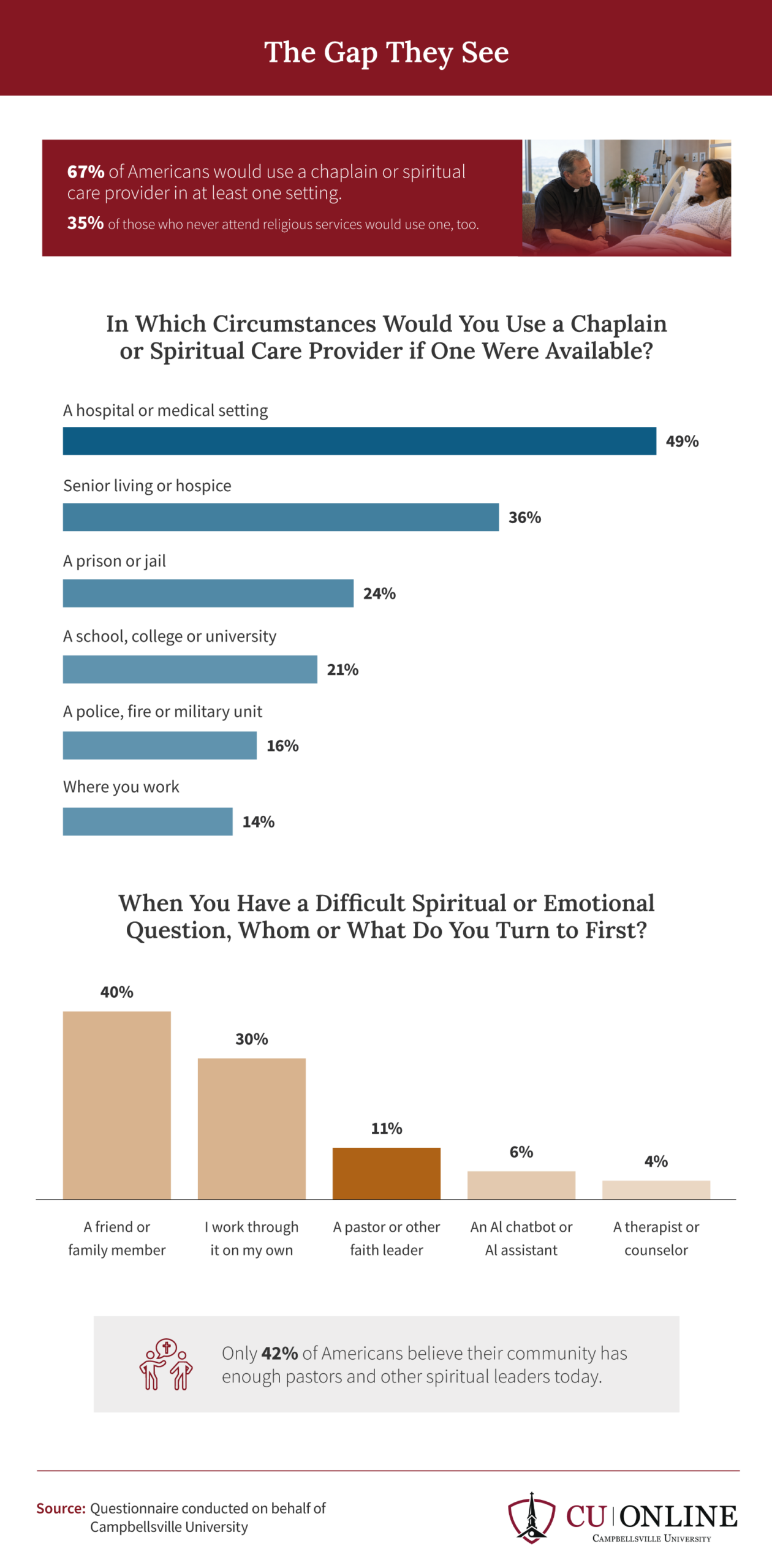
Many Americans surveyed also said they are open to receiving spiritual care. Overall, 67% said they would use a chaplain or spiritual care provider in at least one setting, while 35% of people who never attend religious services said they would as well.
When Americans face a difficult spiritual or emotional question, they most often turn to a friend or family member first (40%). More than one in 10 respondents (11%) would approach a religious leader before anyone or anything else. Fewer would turn to an AI chatbot or assistant (6%).
What Makes Ministry Education More Accessible
For adults already interested in faith-based leadership, the format of an online graduate program can make a substantial difference. Flexible options make pursuing theological education more realistic for people who need to balance studies with work, family and other responsibilities.
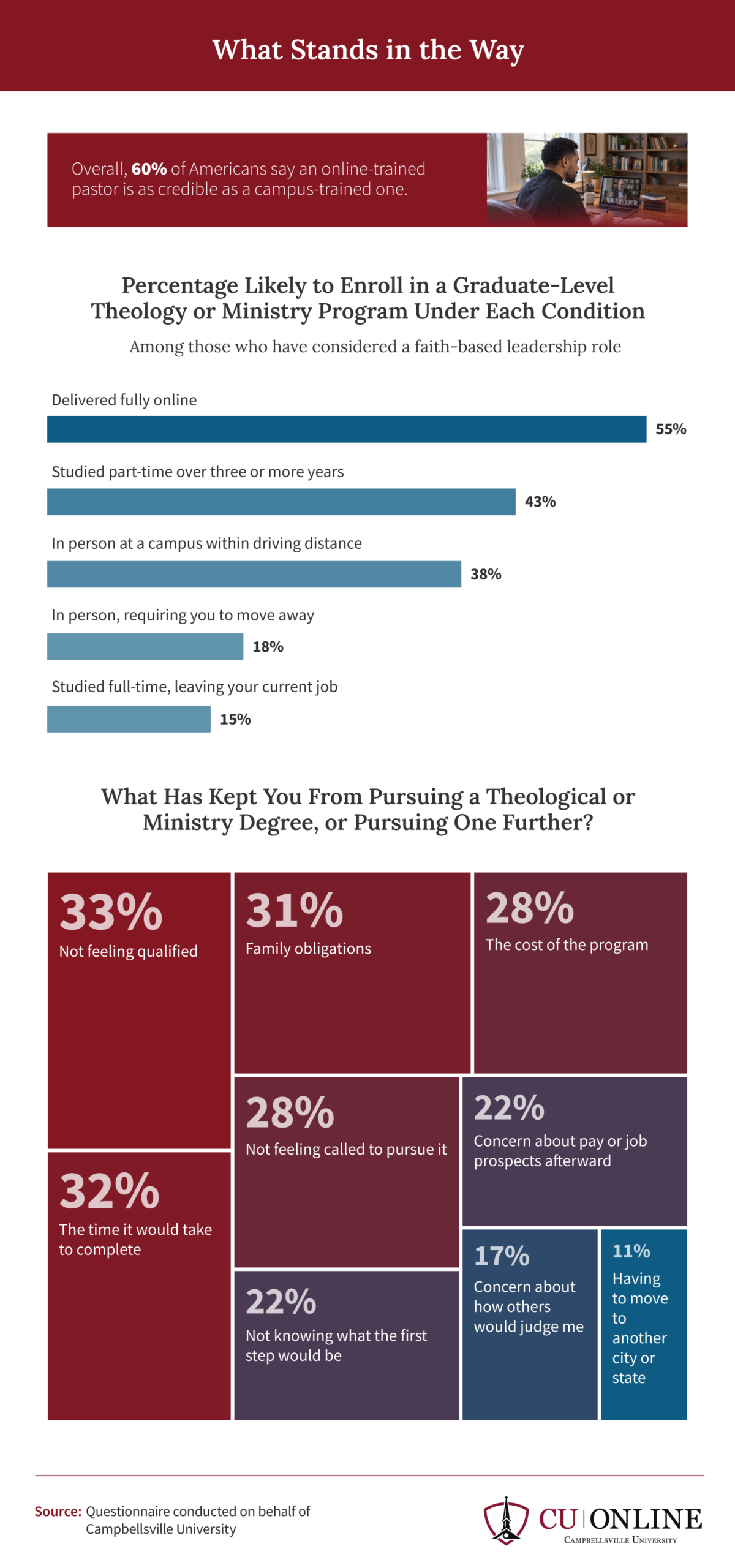
Among those who have considered a faith-based leadership role, 55% said they would be likely to enroll in a graduate-level theology or ministry program if it were delivered fully online. Forty-three percent would consider studying part-time over three or more years, while 38% would enroll in person if the campus were within driving distance.
Options requiring a bigger change drew less interest. Only 18% said they would be likely to enroll if attending in person required them to move away, while 15% would do so if studying full time meant leaving their current job.
That difference helps explain why online theological education may appeal to adults who are already established in their careers and communities. It is also a model many Americans view as credible, with 60% saying a pastor trained entirely online is as credible as one trained on campus.
Considered ministry but never took the next step?
Campbellsville University's online Master of Divinity is built for adults balancing work, family and church commitments.
Learn MoreWhat Stands Between Interest and Enrollment?
Among those who considered a theological or ministry degree, 33% said not feeling qualified had kept them from pursuing it or going further. That was the most commonly cited barrier, followed by the time required to complete the program (32%) and family obligations (31%).
Cost was also a concern, cited by 28%. The same share said not feeling called to pursue the degree had held them back. Other concerns were less common, with 17% worried about how others would judge them and 11% saying that having to move to another city or state had held them back.
Making theological education more accessible is not only about reducing financial barriers. Adults considering ministry may also need a clearer sense of where they fit, what the path requires and whether they can pursue it without stepping away from the lives they have already built.
A Path Forward for Adults Considering Ministry
Americans’ expectations for spiritual leadership point to continued uncertainty about whether communities will have enough pastors and other spiritual leaders. Fewer than half believe their communities have enough today, and confidence falls further when they look a decade ahead.
At the same time, more than a third of Americans have already considered ministry or another faith-based leadership role. Many have not acted on that interest, but the survey shows that flexible study options could make the path more realistic.
For adults balancing work, family and other responsibilities, an online or part-time graduate program can make theological education more accessible without requiring them to put the rest of their lives on hold. That flexibility may help more adults explore whether ministry is a path they are ready to pursue.
Methodology
A questionnaire was conducted on behalf of Campbellsville University of 589 American adults about ministry, theological education and spiritual calling in modern life. The gender breakdown was women (56%), men (42%) and non-binary, preferring not to answer or another gender identity (2%). The generational breakdown included millennials (47%), Gen X (26%), Gen Z (19%) and baby boomers and older (9%). On religious service attendance, 25% attend weekly or more often, 9% once or twice a month, 12% a few times a year, 16% less than once a year and 35% never. The survey was conducted in September 2026. All percentages are rounded to the nearest whole number.
This is a non-scientific, exploratory questionnaire designed to explore behavioral and attitudinal trends. It is not intended to represent all American adults.
About Campbellsville University
Campbellsville University is a faith-based institution in Campbellsville, Kentucky, that has expanded its reach through fully online programs designed for working adults. Our online Master of Divinity program prepares students for pastoral ministry, chaplaincy and other leadership roles through courses that run on an eight-week cycle. The format allows students to stay in their current jobs and congregations while they train. For anyone who has carried the thought of ministry without acting on it, the program offers a practical place to begin.
Fair Use Statement
The findings on this page are available for noncommercial use only. Please provide proper attribution to Campbellsville University and a link back to this page whenever you share them.