

Music education can leave an impression that extends well beyond rehearsals, performances and the classroom. As schools respond to changing technology, student interests and funding priorities, understanding how people value these programs can offer insight into the role music plays in education.
On behalf of Campbellsville University, a questionnaire was administered to 588 music enthusiasts with connections to music education. Campbellsville sponsored the research to better understand how music education influences students and how Americans with an interest in music view its place in schools. For current and aspiring music educators, these perspectives can help contextualize the value of the work they do and the programs they hope to sustain.
Key Takeaways
- 66% of music enthusiasts who took part in school music say their band, choir or music teacher was more memorable than their other teachers
- Music class beats sports as the school experience music enthusiasts remember most vividly (34% vs. 14%)
- 65% of music enthusiasts say social media makes young people more interested in learning a real instrument, and 20% say the same of AI-generated music
- 80% of music enthusiasts would protect school music programs from budget cuts, and 80% want funding to increase
- 51% say music education is more essential now than it was five years ago
Music Education Creates Lasting School Memories
School experiences can stay with people long after graduation, particularly when an educator helps students develop skills, interests and confidence. Music education can create these connections through shared practice, creative expression and relationships with teachers and classmates.
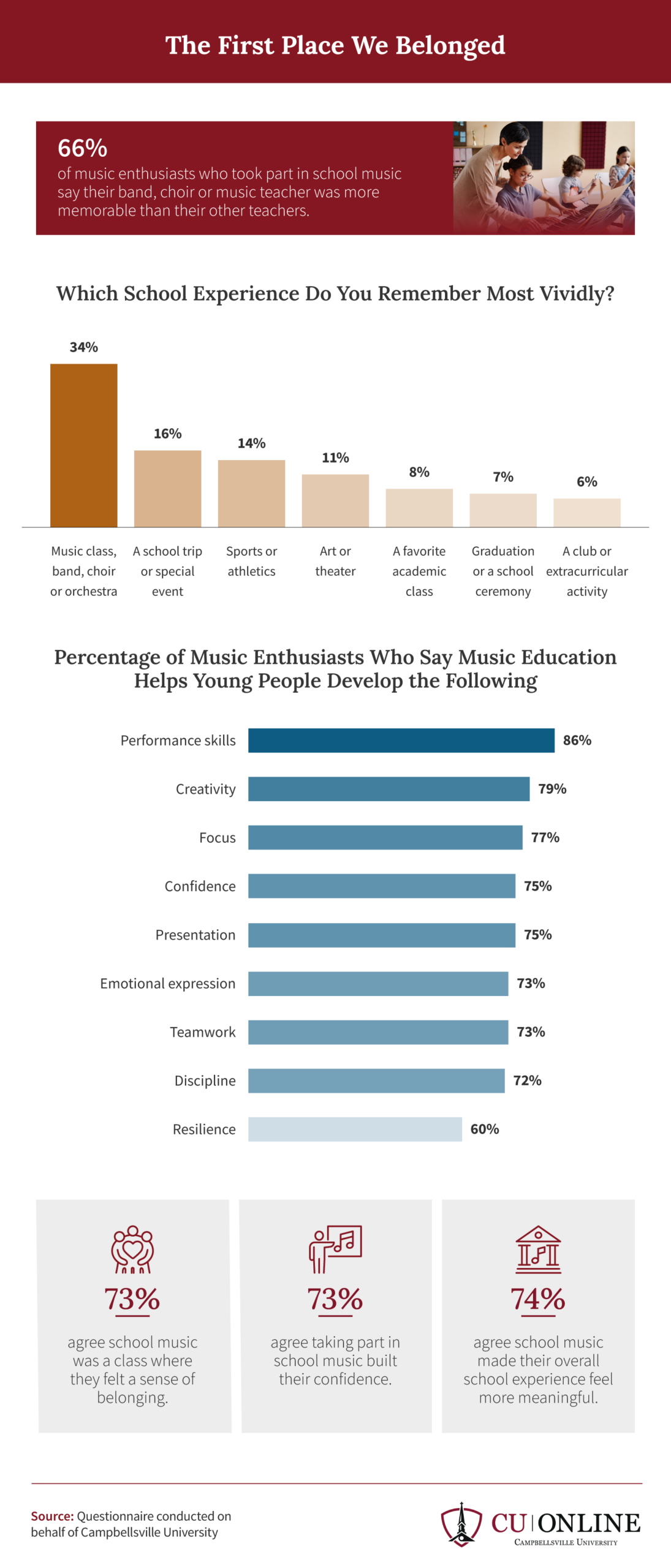
Music educators hold a distinctive place in many former students’ memories. Among music enthusiasts who participated in school music, 66% said their band, choir or music teacher was more memorable than their other teachers.
Music class also stood out when respondents considered their broader school experiences. More than one-third (34%) remembered music class most vividly, compared with 14% who said the same about sports. For many, music programs made their school experience more meaningful (74%) and helped create a sense of belonging (73%).
There are many skills and traits that music education can help young people to develop. The top three, according to music enthusiasts, are performance skills (86%), creativity (79%) and focus (77%). Among program participants, 73% shared that school music increased their confidence.
Technology and Music Teachers Shape Student Interest
Technology continues to influence how students discover music, learn new skills and explore creative interests. At the same time, educators can provide the personal guidance and encouragement that digital tools cannot replicate on their own.
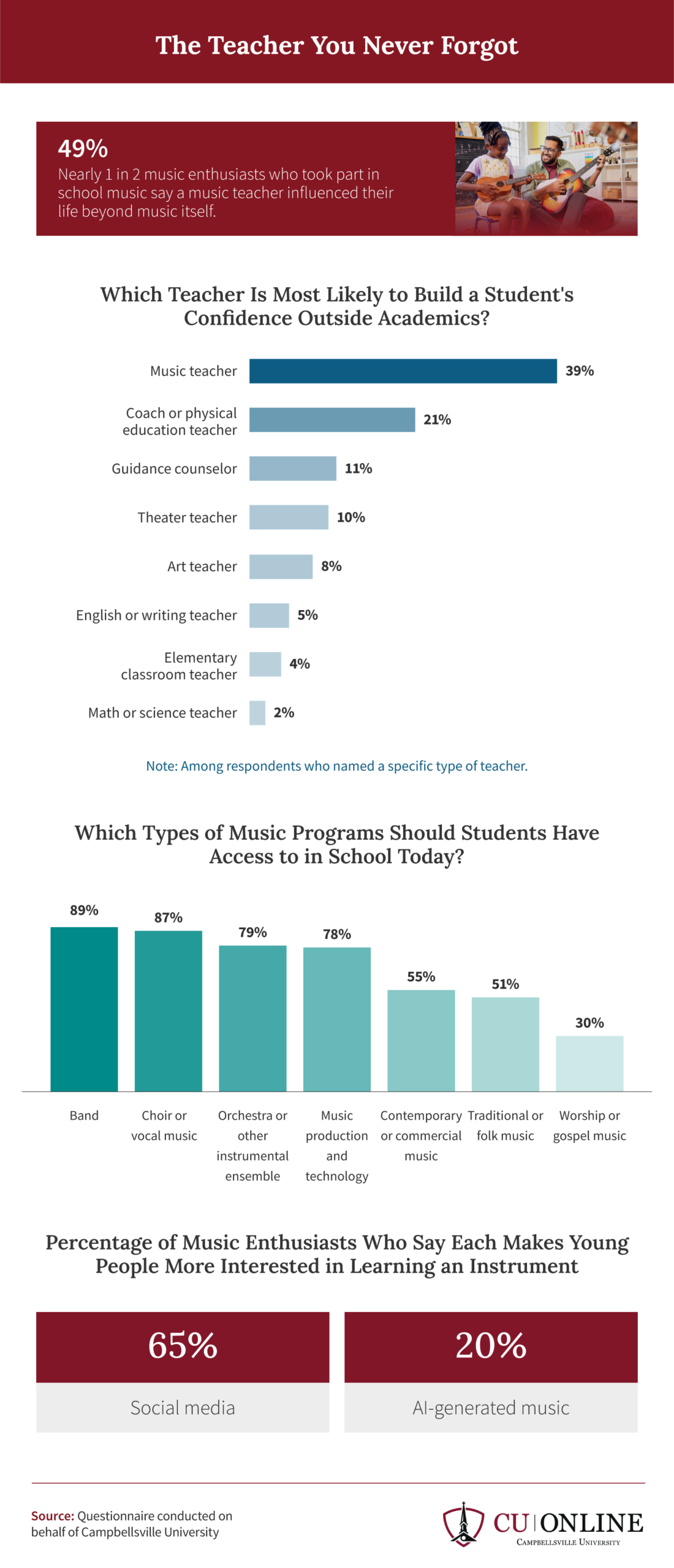
Social media appeared to encourage interest in hands-on music making. Nearly two-thirds of music enthusiasts (65%) said social media makes young people more interested in learning a real instrument, while only 20% said the same about AI-generated music.
Respondents also expressed strong interest in giving students access to newer forms of music education alongside traditional ensembles. Orchestra was supported by 79% of music enthusiasts, while 78% wanted schools to offer music production and technology.
The influence of music educators also extended beyond teaching musical skills. When asked which educator was most likely to build a student’s confidence outside academics, 39% named the music teacher, compared with 21% who selected a coach.
Ready to have that kind of impact in your own classroom?
Campbellsville University's online Master of Music in Music Education helps practicing teachers sharpen their craft and lead stronger programs.
Learn moreSupport for School Music Education Remains Strong
Decisions about school programs often require communities to consider which educational experiences they value and want to preserve. For music enthusiasts, access to music education represented a priority worth supporting as schools plan for the future.
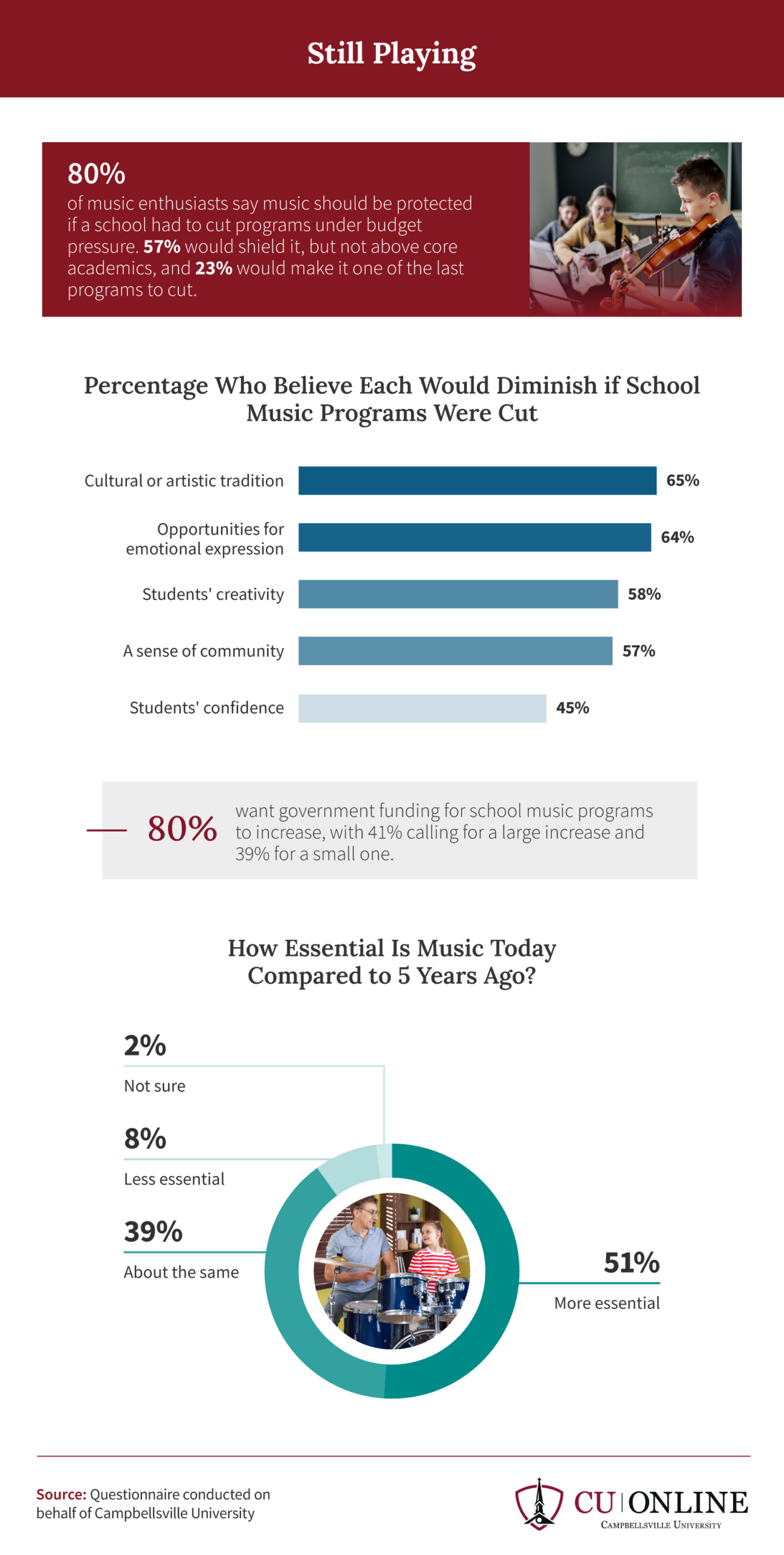
Eight in 10 music enthusiasts said they would protect school music from budget cuts. An equal share wanted government funding for school music programs to increase, indicating broad support among respondents for maintaining and expanding access.
More than half (51%) also said music education is more essential now than it was five years ago. These findings reflect a belief among surveyed music enthusiasts that music should continue to hold a meaningful place in students’ educational experiences.
Without school music programs, enthusiasts most commonly believed that cultural or artistic traditions would diminish (65%). Many also agreed that opportunities for emotional expression (64%), students’ creativity (58%) and a sense of community (57%) would decrease.
Music Education’s Role in the Future of Learning
Music has an enduring place in how people remember school and what they want for the next generation of students, and educators sit at the center of that value. For those entering or advancing in the field, the findings describe a role that reaches past technique and repertoire into the parts of a student’s life that last. Educators who want to deepen that impact can build on their teaching and musicianship through advanced degree programs designed for practicing teachers who want to grow without stepping away from the classroom.
Methodology
A questionnaire was administered to 588 music enthusiasts in the U.S. on behalf of Campbellsville University about the lasting value of school music education. Respondents qualified by being a former participant in school music, a current or aspiring music educator, someone who has personally studied or played a musical instrument or sung in a group, or a parent or guardian of a school-age child; those selecting none of these were screened out.
The gender breakdown was women (59%), men (39%) and non-binary, preferring not to answer or another gender identity (2%). The generational breakdown was millennials (45%), Gen X (29%), Gen Z (20%), and baby boomers and older (6%). In relation to music education, 68% were former participants in school music, 63% have personally studied or played an instrument or sung in a group, 34% are parents or guardians of a school-age child and 5% are current or aspiring music educators. The survey was conducted in July 2026. All percentages are rounded to the nearest whole number.
This is a non-scientific, exploratory questionnaire designed to explore behavioral and attitudinal trends. It is not intended to represent the opinions of all music enthusiasts.
About Campbellsville University
Campbellsville University offers accredited online programs built for working professionals who want to advance their careers without pausing their job or life. Our online Master of Music in Music Education program helps practicing educators deepen their musicianship and teaching skills while continuing to lead classrooms and studios of their own. Learn how the program can help you grow as a music educator on a schedule that fits your life.
Fair Use Statement
The information in this article may be used for noncommercial purposes only. When sharing these findings, please provide proper attribution to Campbellsville University and include a link to this page.