

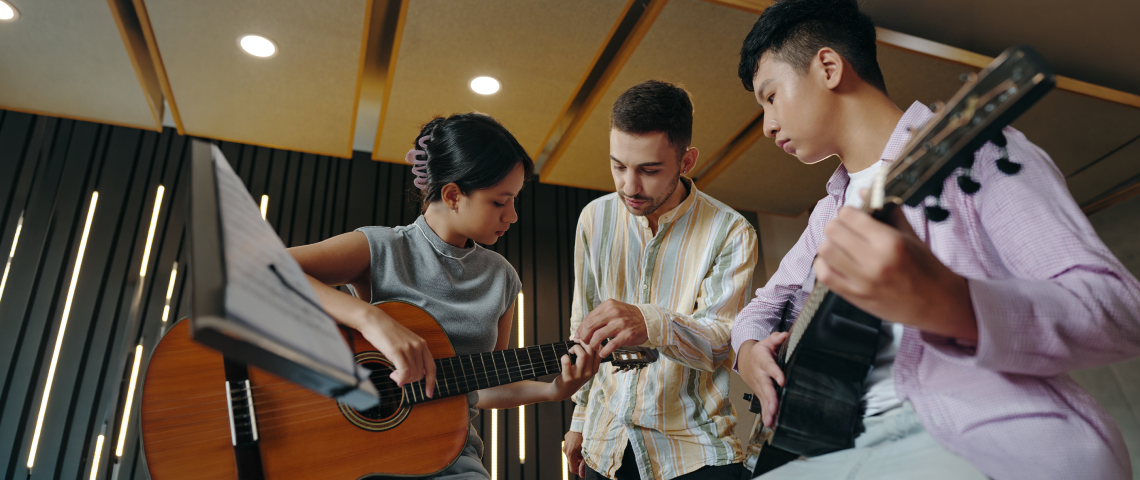
A middle school choir room or an after-school guitar lesson doesn’t look like career prep. But for many adults, it turns out to be exactly that. Campbellsville University commissioned a survey of 1,011 U.S. adults about the music teachers who shaped them. Researchers found that skills built in music class are showing up decades later in job promotions, public speaking and how people describe their own creativity.
As AI takes over more routine tasks, that shift is changing how Americans see the value of a music class. Parents also want schools to modernize music education, adding skills like music marketing and responsible AI use alongside traditional instruction.
Key Takeaways
- More than 1 in 10 Americans (14%) say a music teacher had the most meaningful personal influence on their life, compared to all their other teachers.
- Adults who took music classes in school are more likely to have landed a promotion or major responsibility increase (25%) than those who didn’t (18%).
- 36% of Americans say creative education feels more valuable now because of AI.
- 82% of Americans say music education should be expanded or at least maintained at the current level.
- Adults who took music classes in school are more comfortable than those who didn’t with performing, presenting or speaking under pressure today (57% vs. 49%).
The Teacher Who Stayed With You
For many adults, music class is where they first learned to handle pressure, take direction, and trust their own ability to create. Those lessons don’t stay in the classroom.
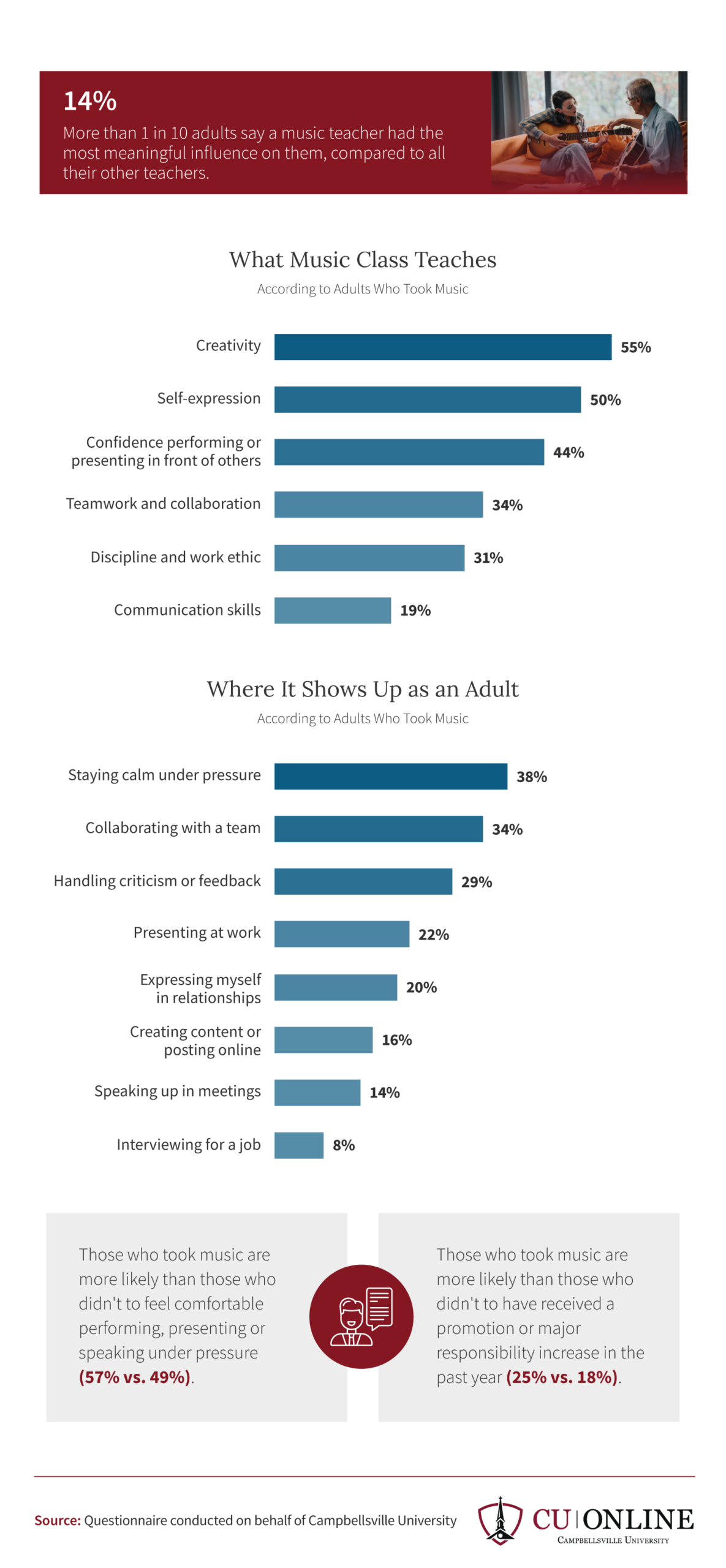
More than one in 10 Americans (14%) said a music teacher had the single most meaningful influence on their life, more than any other type of instructor. That influence followed people into their careers. Adults who took a music class in school were more likely to have landed a promotion or major responsibility increase in the past year than those who didn’t, 25% compared with 18%.
The effect also showed up under pressure. Adults who took music in school (57%) are more comfortable performing, presenting or speaking under pressure today than those who didn’t (49%). Among adults who took music, half or more credited it with building their creativity (55%) and self-expression (50%). About two in five (38%) said they know how to stay calm under pressure as adults because of music education.
Turning Your Classroom Influence Into a Career
Campbellsville University's online Master of Music in Music Education helps working teachers deepen their musicianship and leadership skills without stepping away from the classroom.
View programCreativity in the Age of AI
As AI takes over more routine tasks, Americans increasingly see creativity itself as a professional advantage. That shift showed up clearly in this survey.
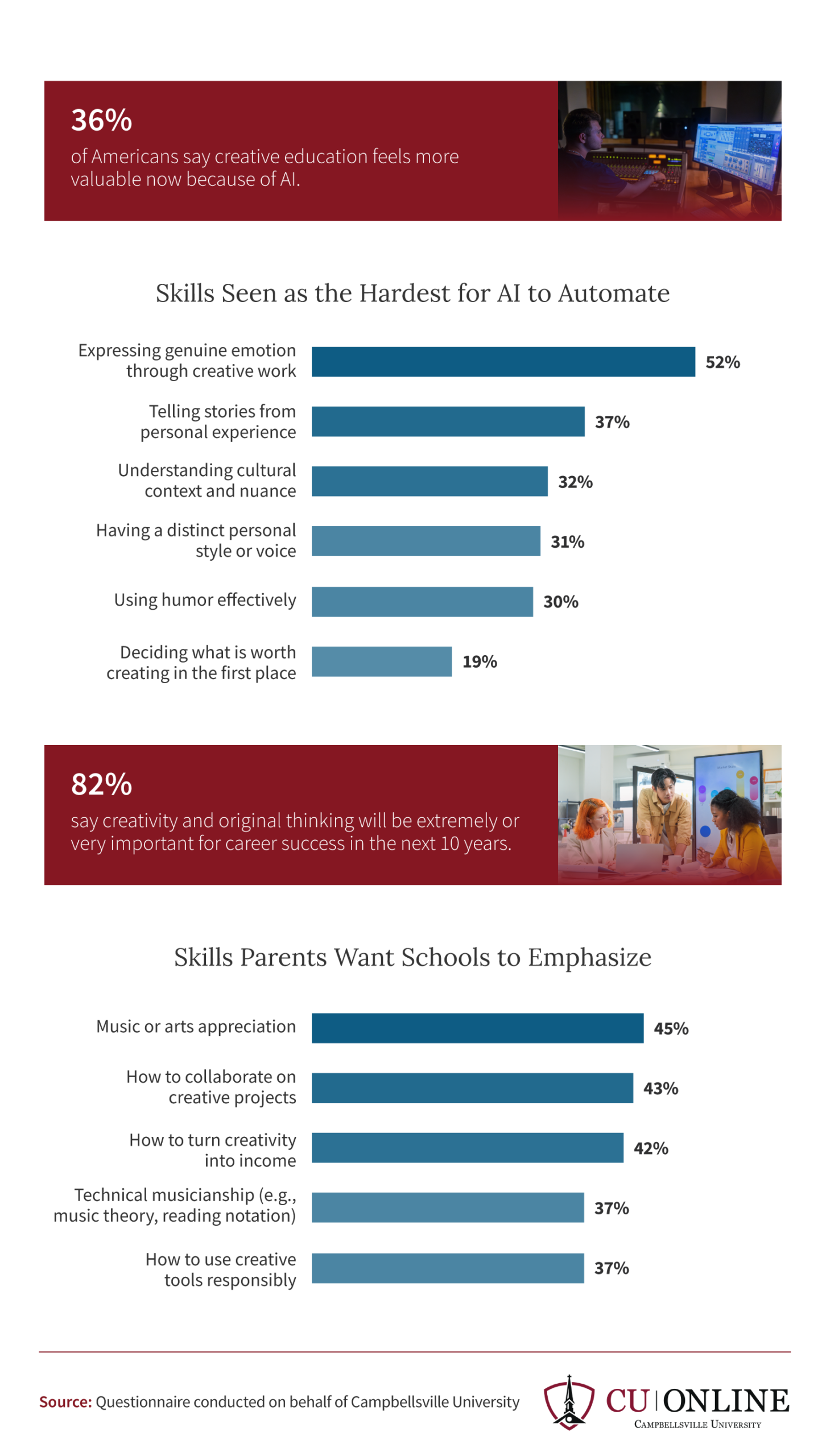
More than a third of Americans (36%) said creative education feels more valuable now because of AI. That tracked with what people thought AI still couldn’t do well, with 52% pointing to expressing genuine emotion through creative work as one of the hardest skills for AI to automate, followed by telling stories from personal experience (37%).
Looking ahead, 82% said creativity and original thinking would be extremely or very important for career success over the next decade. Parents surveyed wanted music and arts classes to reflect that shift, ranking learning to collaborate on creative projects (43%) and turning creativity into income (42%) among the skills they’d most like schools to emphasize.
Why Most Parents Want Music Class to Grow, Not Shrink
Parents aren’t just protective of music class. Many want to see it expanded and modernized.
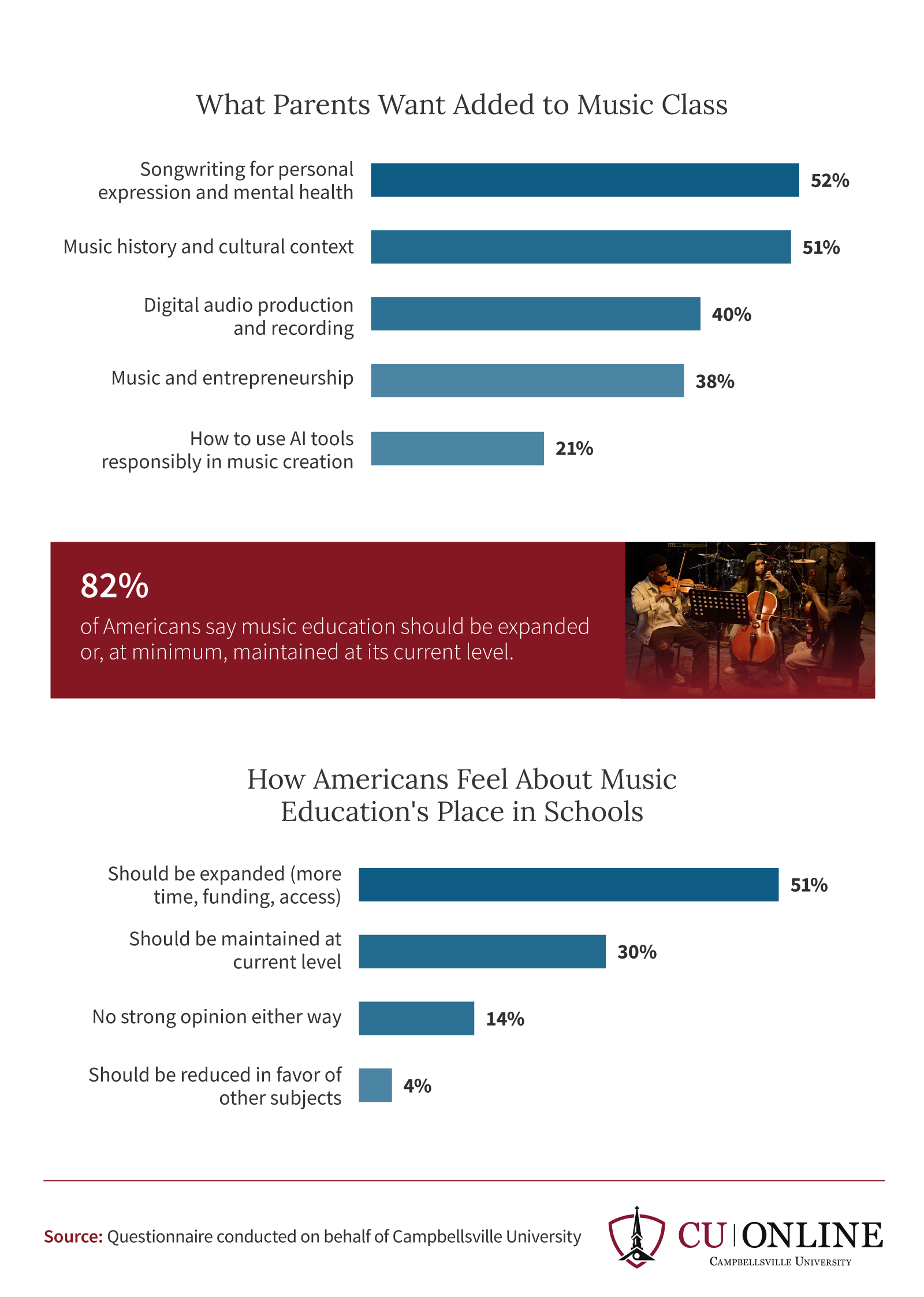
Most Americans (82%) said music education should be expanded or at least maintained at its current level in schools, including 79% of parents. Just 4% thought schools should scale it back in favor of other subjects.
Parents’ wish list for music class was a mix of personal improvement, history and career prep. Their top requests were songwriting for personal expression and mental health (52%) and learning about music history and cultural context (51%). Others wanted music classes to be about digital audio production and recording (40%) and music entrepreneurship (39%). Roughly one in five parents (21%) also wanted lessons on how to use AI tools responsibly in music creation.
Why Music Educators Matter More Than Ever
Across generations, students who sang, played and performed carried more than a hobby into adulthood, and the teachers who guided them often made the difference. As AI raises the value of creativity, self-expression and the human-centered skills machines can’t easily replicate, the educators who teach those skills are becoming more essential, not less.
For music teachers ready to deepen their craft and lead in the classroom, that shift is an opportunity, and advanced training is one way to meet it. The demand is clear in the data, and the next generation of students is waiting for teachers prepared to meet it.
Methodology
A questionnaire on behalf of Campbellsville University surveyed 1,011 U.S. adults ages 18 and older between July 28 and August 3, 2026. Generations were derived from reported age brackets and mapped to standard cohort definitions (Gen Z, ages 18 to 24; millennials, ages 25 to 44; Gen X, ages 45 to 64; baby boomers, ages 65 and older). Questions about music education’s specific effects (skills developed, adult situations helped) were asked only of the 784 respondents (78%) who reported taking a music class in school. Questions about school experience and priorities were asked only of the 364 respondents who identified as a parent or guardian of a child currently enrolled in a K-12 school. All percentages are based on the number of respondents who answered each individual question, not the total sample, and are rounded to the nearest whole number. For questions allowing multiple responses, percentages reflect the share of respondents who selected each option and will not sum to 100%.
About Campbellsville University
Campbellsville University offers accredited online programs built for working professionals who want to advance their careers without pausing their job or life. Our online Master of Music in Music Education program helps practicing educators deepen their musicianship and teaching skills while continuing to lead classrooms and studios of their own. Learn how the program can help you grow as a music educator on a schedule that fits your life.
Fair Use Statement
This report and its images are available for noncommercial reuse. If you use any of this content, please link back to this page and credit Campbellsville University.