


A social work degree covers theory, ethics and assessment, then a graduate walks into a room with a family in crisis and finds out what the coursework left out. The first caseload tests skills no syllabus fully addresses, from holding a boundary under pressure to carrying a client’s situation home at night. Practitioners in those early months learn quickly which parts of their training held up.
Campbellsville University‘s online Master of Social Work (MSW) program prepares social workers for direct-service practice, so the distance between the classroom and the caseload is worth measuring. To map it, Campbellsville commissioned a survey of 188 new social workers who earned their first social work degree from a variety of universities between 2021 and 2026 and who work, or recently worked, in client-facing roles. Their answers identify where preparation falls short, what the job costs practitioners personally and which training experiences produce people ready for the work.
Key Takeaways
- Fewer than one in 10 new social workers (9%) feel fully prepared for day one.
- 30% of new social workers feel unprepared for the emotional weight of the work, more than for any other part of the job.
- 42% of social workers regularly think about a client’s situation outside of work hours.
- 76% of new social workers have paid out of pocket for something a client needed, and those who do report an average of $79 over the past year.
- 39% of social workers say they were hit with something their training didn’t prepare them for within the first month.
- Without good first-year supervision, 88% of new social workers have considered leaving the field.
- Peer support (72%), post-graduation mentorship (68%) and field placement (66%) are rated the most useful parts of training for real client work.
Day One and the 12 Months That Follow
Every new practitioner remembers the first case that did not resemble anything from a textbook. Some arrive steady and find the work close to what they pictured, while others meet a situation in week two that no seminar covered.
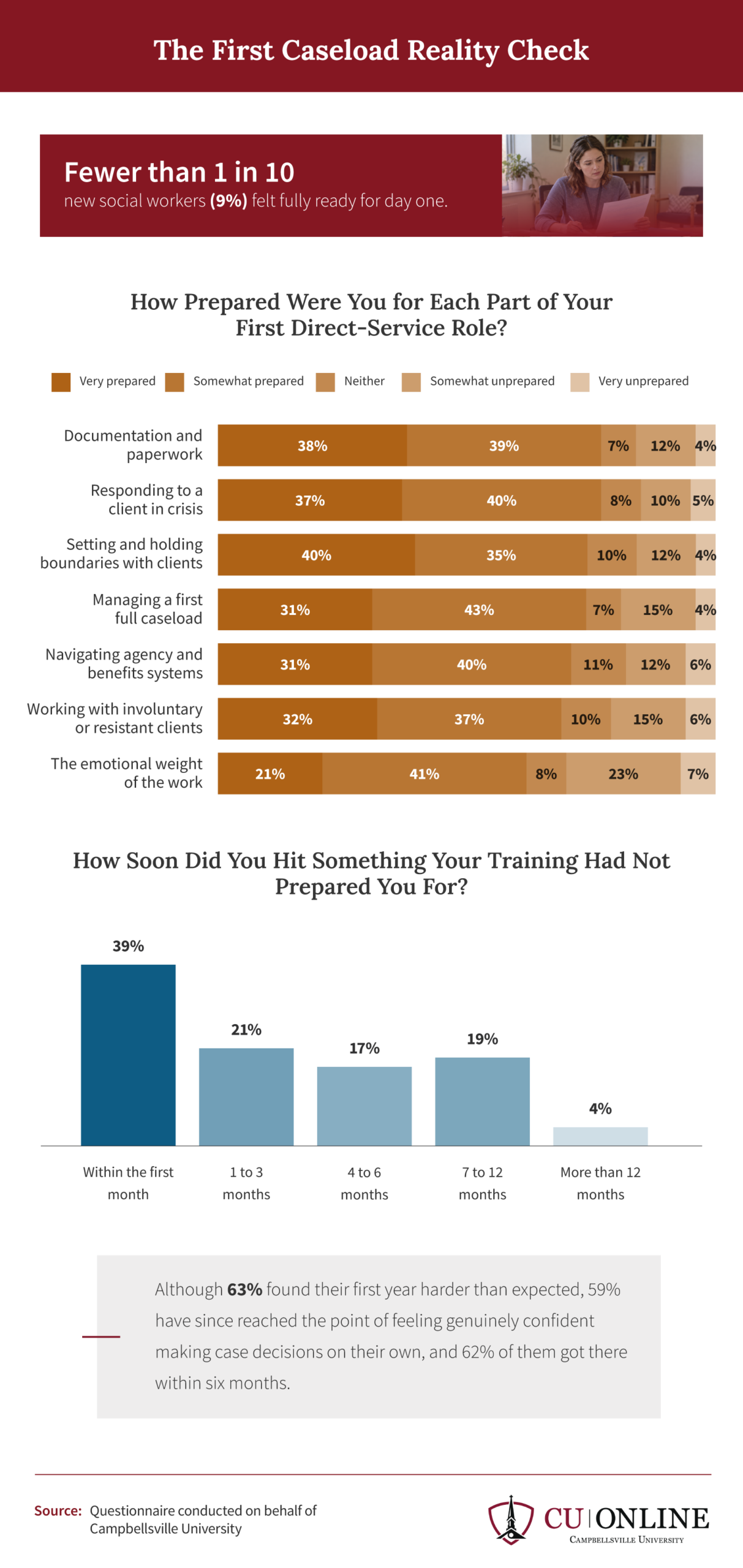
Full readiness on day one is rare. Only 9% of new social workers felt fully prepared when they started, and 39% reported being hit with something their training did not cover within the first month. Surprise, for most of this group, arrived almost immediately.
Expectations held up better for a meaningful minority. Among respondents, 29% found the first year about what they expected and 8% found it easier than anticipated. Training landed hardest on three specific skills, with 40% feeling very prepared for boundaries, 38% for paperwork and 37% for crisis response.
Confidence follows a fairly predictable curve. Among those who reached it, 86% felt genuinely confident making case decisions on their own within a year, 62% within six months and 28% within three months. The first year serves as the real training period, regardless of the degree covered.
Career doubt tends to surface in that same window. Among new social workers, 28% first thought seriously about leaving the field during their first year, while 26% have never thought seriously about leaving at all.
What the Job Costs After Hours
Direct-service work does not end when a shift does. Cases follow practitioners into evenings and weekends, and the financial line between personal and professional blurs when a client needs something the agency will not cover. These costs rarely appear in a job description.
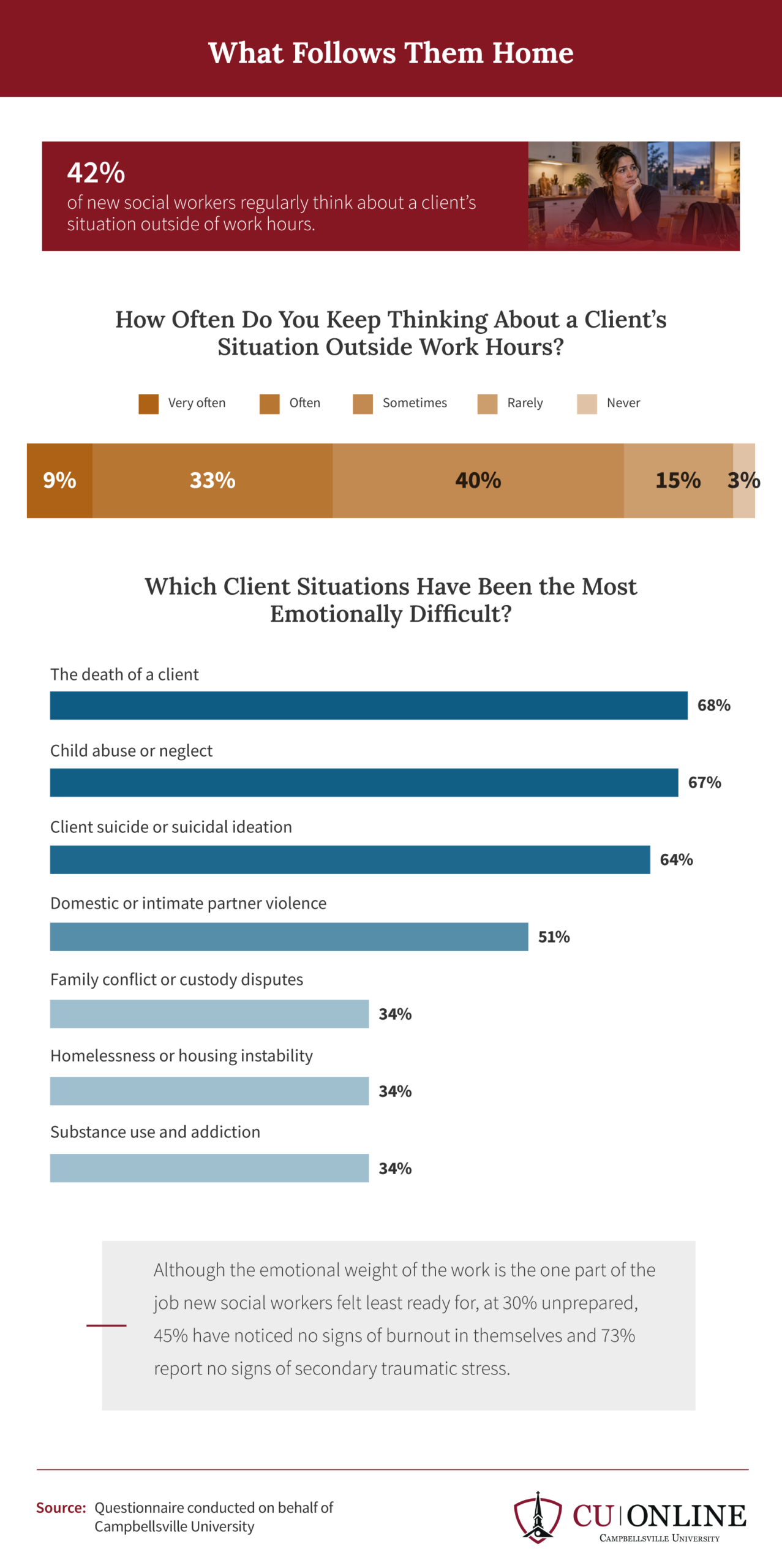
Emotional load ranked as the least anticipated part of the work. Among new social workers, 42% regularly thought about a client’s situation outside of work hours, and 30% felt unprepared for the emotional weight of the job. Nothing else in the survey caught practitioners off guard to the same degree.
What follows people home depends heavily on where they work. School-based practitioners reported the highest rate at 62% thinking about a client outside work hours often or very often, followed by 54% in child welfare, against 30% in behavioral health. Setting shapes the weight as much as caseload size does.
Out-of-pocket spending has become routine. Among respondents, 76% have paid for something a client needed, averaging $79 over the past year, and the practice runs heaviest in child welfare at 86%, compared with 73% in behavioral health and 57% in housing services. Unpaid time adds to the total, with 56% regularly working unpaid hours that average six hours a week.
Burnout builds slowly rather than arriving all at once. Among the 55% who noticed signs of burnout in themselves, it first appeared:
- Within the first month: 5%
- 1 to 3 months: 17%
- 4 to 6 months: 30%
- 7 to 12 months: 26%
- More than 12 months: 22%
Support during that stretch is harder to reach than it should be, with 44% calling access to supervision very difficult.
What Actually Produces a Job-Ready Practitioner
Programs cannot simulate every situation a caseload will produce, but the survey points clearly toward the experiences that matter most. Two factors stand out for how strongly they move a practitioner’s commitment to the profession. Both happen through relationships rather than curriculum.
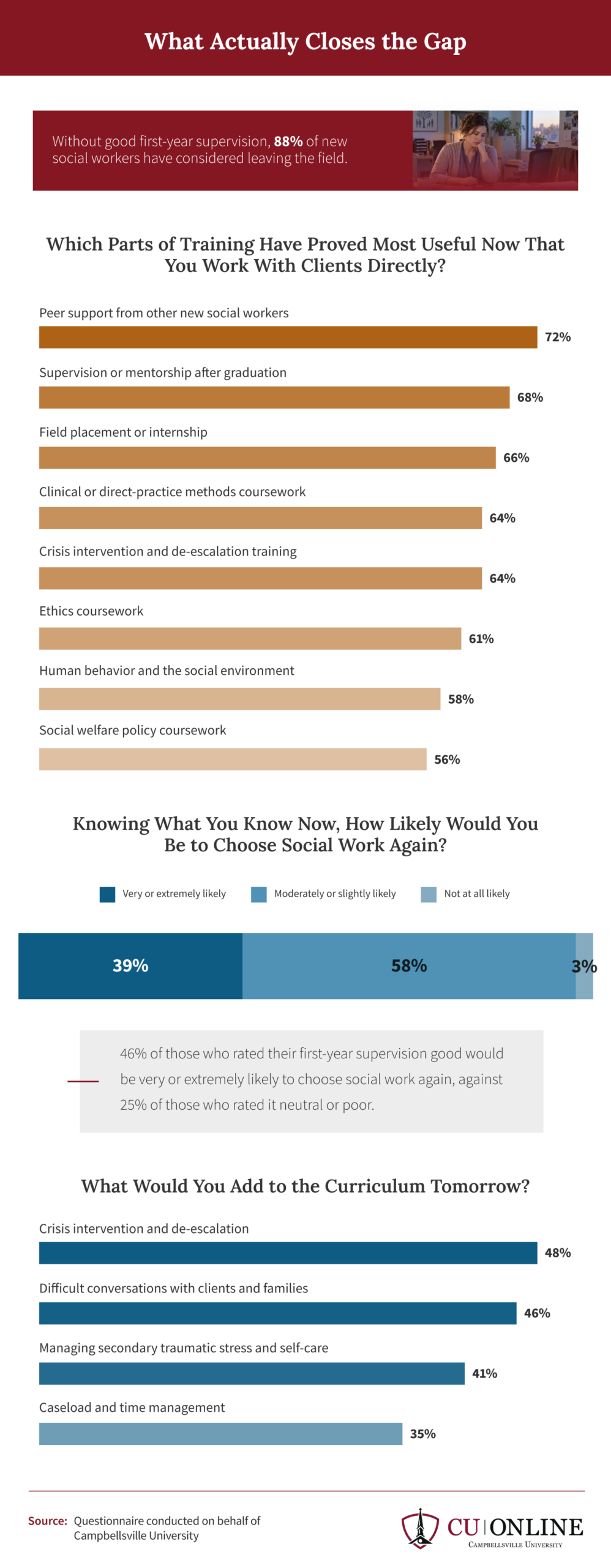
Supervision quality in year one carries enormous weight. Two-thirds of new social workers (66%) rated their first-year supervision as good or very good, while 25% called it neither good nor poor and 9% called it poor. Poor supervision has consequences: 88% of social workers who didn’t receive good supervision have considered leaving the field.
Strong supervision nearly triples the share of practitioners who never question their career. Among those who rated their first-year supervision as good, 33% have never thought seriously about leaving the field, compared with 12% of those who rated it neutral or poor. Early guidance early on changes the long-term picture.
Realistic field placement moves commitment just as forcefully. Among practitioners whose placement closely resembled the job, 61% would choose social work again, compared with 31% of those whose placement did not. A practicum that mirrors real conditions functions as a preview rather than an exercise.
What graduates want added to their training is clinical rather than administrative. Peer support, post-graduation mentorship and field placement ranked as the most useful parts of training for real client work, at 72%, 68% and 66%. Administrative topics sit at the bottom of the list, with documentation efficiency at 28%, navigating agency systems at 25% and professional boundaries at 23%.
Want a practicum that mirrors the job?
Learn MoreClosing the Gap Between Classroom and Caseload
New social workers described a first year that tests them well beyond what their degrees covered, from the emotional weight of client work to the personal money and unpaid hours the job absorbs. They also identified what protects them, pointing to strong supervision, realistic field placement, peer support and mentorship as the experiences that build readiness and keep people in the profession. Programs that treat those elements as central rather than supplemental send practitioners into the field with a steadier footing.
Methodology
A questionnaire was conducted on behalf of Campbellsville University of 188 new social workers in the United States about their first years in direct-service practice. All respondents completed their first social work degree within the past five years (2021 – 2026), and 86% are currently employed in a direct-service, client-facing role, with the remaining 14% having held one within the past 12 months.
The gender breakdown was men (49%) and women (49%), with the remainder nonbinary or preferring not to answer. The generational breakdown included: Gen Z (46%), millennials (43%), Gen X (11%) and baby boomers and older (1%). In terms of completed social work degrees, 60% hold a BSW, 37% an MSW and 3% a doctorate. On the format of their first social work degree, 63% studied primarily in person, 20% hybrid and 17% primarily online. The survey was conducted in September 2026. All percentages are rounded to the nearest whole number.
About Campbellsville University
Campbellsville University is a faith-based institution in Campbellsville, Kentucky, that delivers its social work programs fully online for students who work while they study. Its online Master of Social Work program is accredited by the Council on Social Work Education and pairs coursework with a supervised practicum in a real practice setting, the experience new practitioners rank among the most useful preparation for client work. An advanced standing track shortens the path for students who already hold a Bachelor of Social Work. For anyone preparing for a first caseload, the program builds the supervised experience that early-career practitioners say makes the difference.
Fair Use Statement
These findings are available for noncommercial use, including in classrooms, agency training and reporting on the social work workforce. Please credit Campbellsville University with a link back to this page whenever you share them.