


Moving into management can open new career opportunities, but leadership also comes with growing demands. Managers are balancing traditional responsibilities like decision-making and employee support with newer expectations around after-hours availability and AI oversight.
A survey conducted on behalf of Campbellsville University asked 609 employed U.S. professionals about their experiences with management and their views on becoming a leader. For professionals considering management or seeking leadership training, their responses offer a closer look at what managers face on the job today and what can help prepare them for the role.
Key Takeaways
- The modern manager is under pressure, with 89% of managers reporting the job is very demanding.
- 18% of managers are expected to be available for work outside normal working hours almost every day.
- 59% of managers are now expected to oversee their team’s use of AI, and 14% of them were given no guidance or training.
- 52% of workers without direct reports say that they would avoid leadership because the pay is too low relative to the responsibility, compared with 31% who say the reason is burnout or stress.
- 56% of workers without direct reports say structured leadership training would make them more willing to take on a leadership role.
- Leaders who received formal training were more than three times as likely as those with no training to say the role delivered career advancement (51% vs. 14%).
The Demands of Management Are Expanding
Managers today are responsible for a wide range of tasks, from supporting employees to making strategic decisions. Some are also expected to remain available outside normal working hours and oversee their team’s use of AI tools.
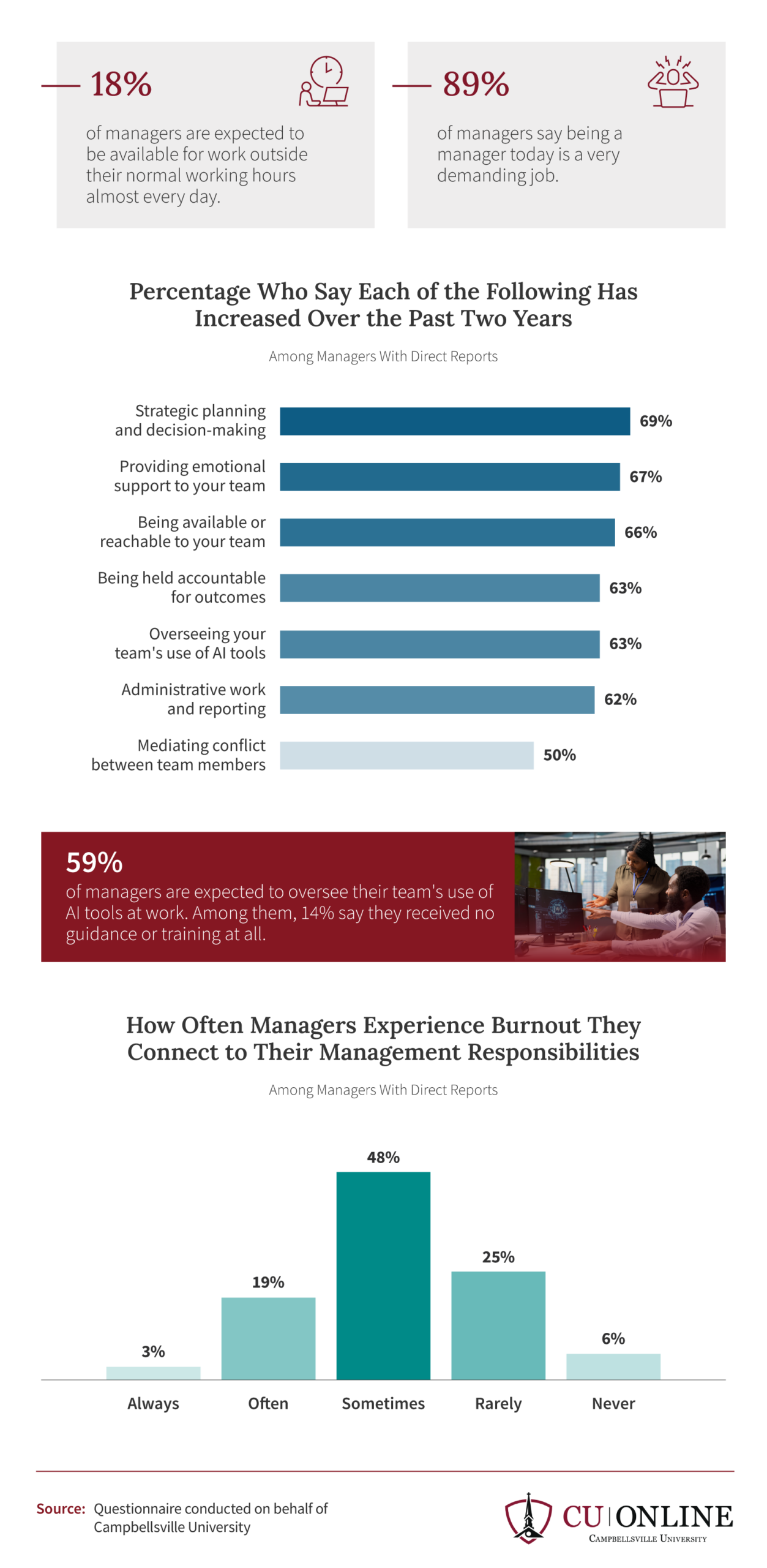
Nearly nine in 10 managers (89%) said being a manager today is a very demanding job. Some are also expected to work beyond their normal schedules, with 18% saying their employer expects them to be available outside normal working hours almost every day.
Managers are also taking on newer responsibilities. About three in five (59%) are expected to oversee their team’s use of AI, although 14% of those managers said they received no guidance or training for it. These responsibilities haven’t necessarily shaken managers’ confidence: 78% said they were very or extremely confident in their ability to manage their teams, while only 2% said they were not confident.
The findings also point to areas where managers could use more support. One-quarter said they wished they had received training on setting boundaries around their own availability, including 30% of women and 20% of men. More than one-third (35%) had considered stepping down from leadership in the past 12 months.
Compensation is another consideration. Only 26% of managers said they receive a lot or a great deal more pay for managing, while 43% reported little or no additional pay and 14% said they receive none.
What Would Make More Workers Want to Lead?
Workers aren’t necessarily opposed to stepping into management. For many without direct reports, better pay and adequate preparation could make the added responsibility more appealing.
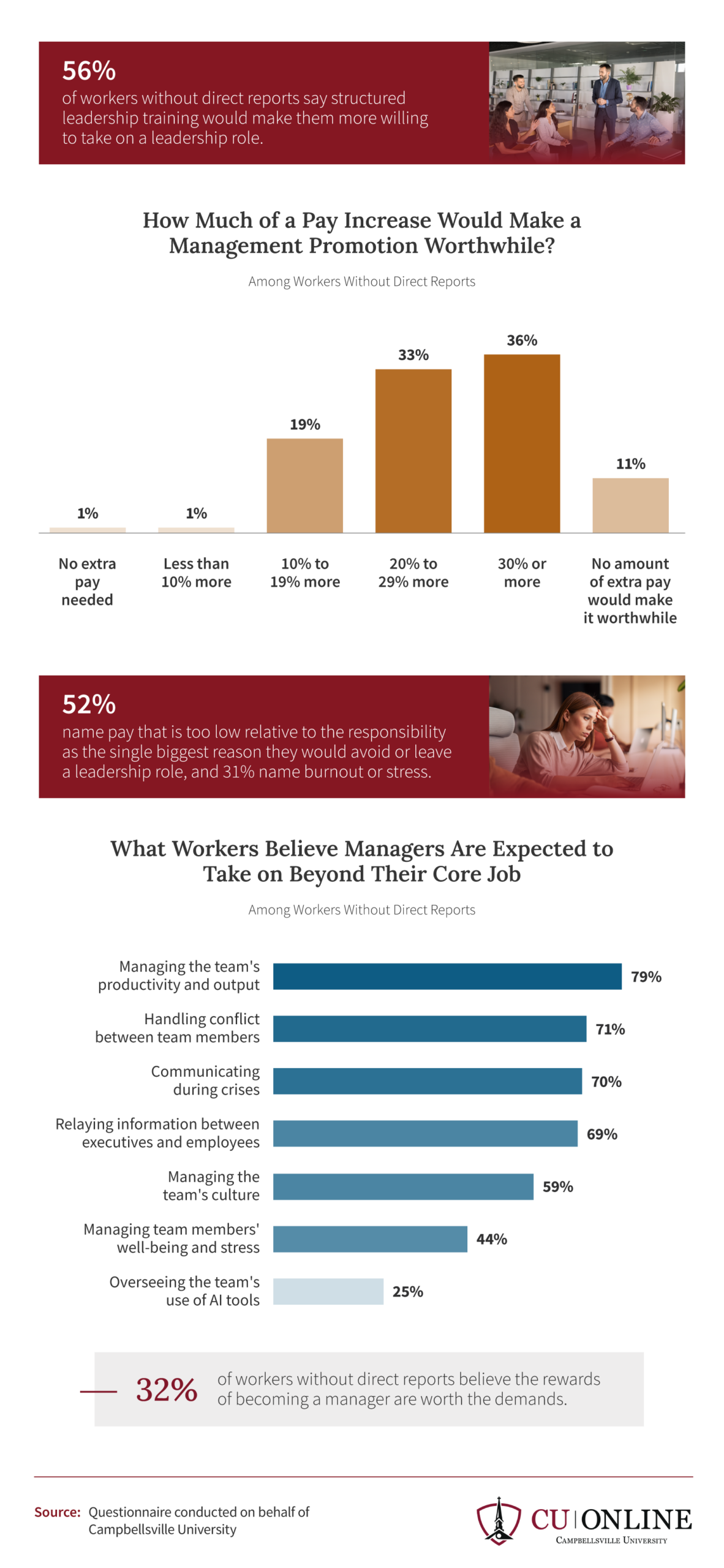
Pay was the most common reason workers without direct reports gave for avoiding management. More than half (52%) said compensation that is too low relative to the responsibility would discourage them from taking a leadership role. Burnout or stress ranked second at 31%.
Most workers also said they would expect a pay increase to take on management responsibilities. Just 1% said they would need no additional pay, while another 1% would accept an increase of less than 10%. In comparison, 19% would want 10% to 19% more, 33% would want 20% to 29% more and 36% would want an increase of at least 30%.
Training may also make leadership roles more appealing. More than half of workers without direct reports (56%) said structured leadership training would make them more willing to take on a leadership role. That increased to 74% among Gen Z, compared with 52% of millennials and 54% of Gen X.
Want the confidence to lead without the guesswork?
Campbellsville's online Master in Management and Leadership program teaches the exact skills this survey shows new managers need most.
Learn moreFormal Training Is Linked to Better Career Outcomes
Formal leadership education is one way professionals can prepare for management responsibilities. The survey also asked workers which skills they believe new managers should develop.
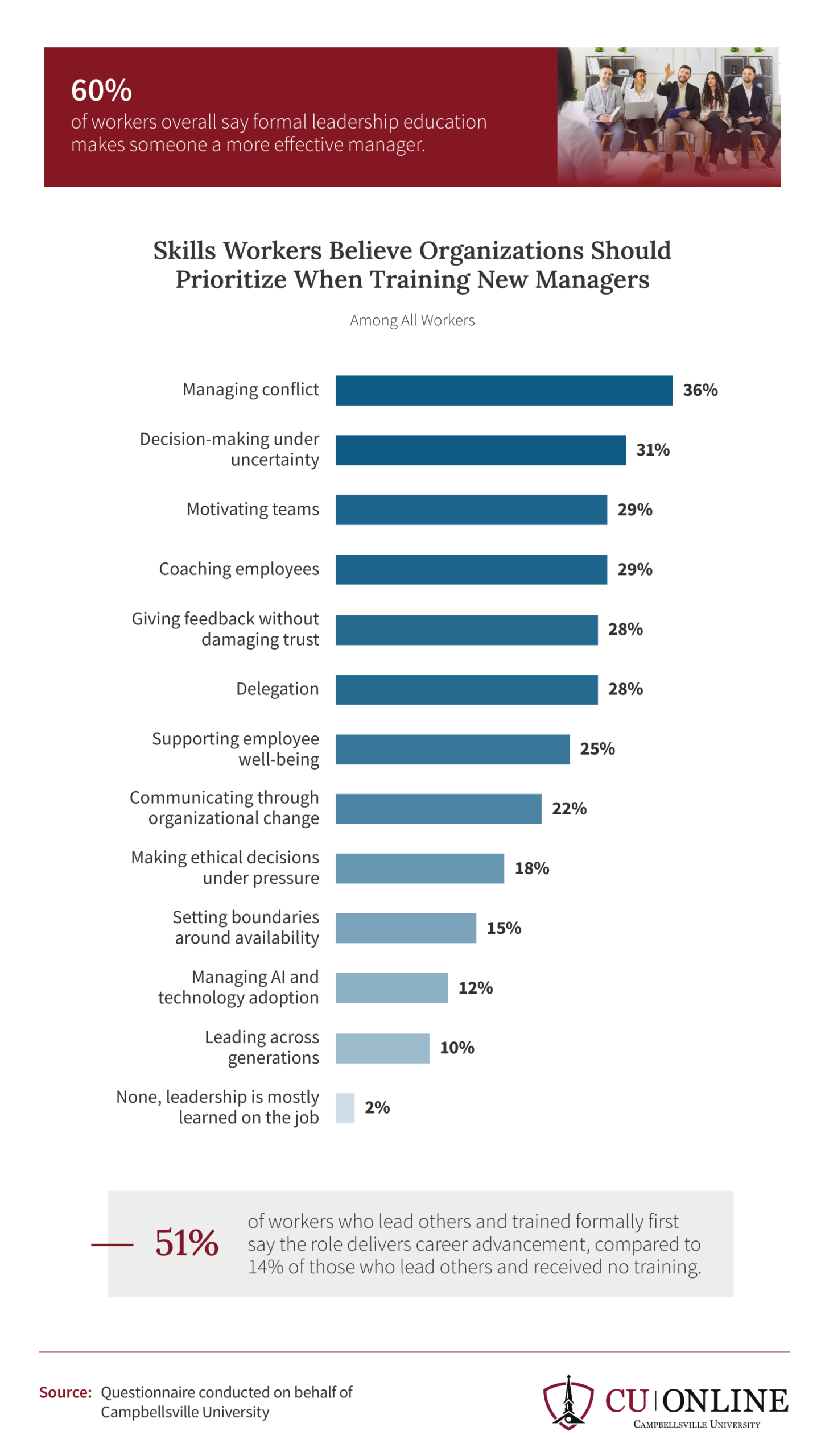
Across all workers surveyed, 60% said formal leadership education makes someone a more effective manager. When asked what organizations should prioritize when training new leaders, respondents pointed to skills such as:
- Managing conflict (36%)
- Making decisions under uncertainty (31%)
- Motivating teams (29%)
- Coaching employees (29%)
- Giving effective feedback (28%)
Managers who received formal training before entering leadership also reported different career outcomes. More than half (51%) said the role delivered career advancement, compared with 14% of managers who received no training. That makes formally trained managers more than three times as likely to report career advancement.
The findings don’t establish that training caused those outcomes, but they show a clear difference between the two groups. Access to leadership education is an important consideration both before and after someone moves into management.
Preparing for the Next Step in Leadership
For professionals considering a move into management, developing leadership skills before taking on the role may help build a stronger foundation for career growth. Formal education can provide opportunities to strengthen skills in areas workers identified as important for new managers. Whether you’re preparing to graduate, pursuing your first management position, or looking to advance in an existing career, leadership education can help you prepare for the responsibilities that come with leading others.
Methodology
A survey was conducted on behalf of Campbellsville University of 609 employed U.S. professionals about the changing demands of management. Respondents were distributed across genders, generations, and levels of leadership responsibility. The gender breakdown was women (50%), men (48%) and non-binary or preferring not to answer (2%). The generational breakdown included millennials (49%), Gen X (30%), Gen Z (16%), and baby boomers (5%).
All respondents were working, with 73% employed full-time, 16% part-time and 11% self-employed. On leadership responsibility, 38% formally manage others and have direct reports, 22% lead others informally or through projects without direct reports and 40% do not currently lead or manage anyone. The survey was conducted in July 2026. All percentages are rounded to the nearest whole number.
About Campbellsville University
Campbellsville University offers accredited online programs built for working professionals who want to strengthen their skills while continuing their careers. Our online Master in Management and Leadership program develops practical leadership skills in areas such as team management, workplace communication, business ethics, conflict management and project management. Learn how the 100% online program can help you prepare for greater leadership responsibilities and take the next step in your career.
Fair Use Statement
This report and its images are available for noncommercial reuse. If you use any of this content, please link back to this page and credit Campbellsville University.